Showing posts with label Morbid. Show all posts

Monday, October 31, 2016

The Writhing Figures: The Short Films of Robert Morgan


I’ve been a fan of animation since I was younger. While I've enjoyed a variety of cartoons, I've found myself interested in darker works, such as shows like Courage the Cowardly Dog, which unsettled me but left me wanting more. There was something about these animations that drew me in, and over the years my search lead me to creators like Robert Morgan.

 Robert Morgan was raised in Yateley, Hampshire. He developed an interest in film after watching Fiend without a Face (1958), which was shown to him by his uncle on an 8mm projector. While attending The Surrey Institute of Art and Design he began experimenting with manipulating sculptures, which lead to him studying animation (“Robert”). I'm enthralled by Morgan's brilliant use of stop motion, one of my favorite types of animation and a style that I wish would be explore more in film. Morgan finds that stop motion animation is a perfect medium to augment the eeriness in his films, as “[t]he way everything moves has an unnatural, uncanny feeling, a weird jerkiness. Everything is alive and dead at the same time” (Vollenbroek). 

Although some of his films are incredibly bizarre by his standards, particularly Overtaken, these short films exhibit a creativity and ingenuity that is lost in many of the mainstream releases today. Overall I greatly enjoy Morgan's works, but there are two in particular that I keep coming back to: The Cat with Hands and The Man in the Lower-Left Corner of the Photograph.


An absolutely brilliant film.

The Cat with Hands is a short film I discovered in my teenage years as I began to explore the Goth subculture. While I was looking for media that would make me appear more “Goth” to my peers, what I got as a brilliantly subtle, yet eerie story based on a recurring nightmare Morgan’s sister had during her youth (Duncan). The brilliant use of animation combined with a succinct plot made for a chilling short film. This is a fantastic work of art that has been one of my favorite films for years. 

The Man in the Lower-Left Hand Corner of the Photograph is a film I discovered after searching for more of Morgan's work. It tells the story of a lonely old man who sees a picture of himself as younger and happier and tries to recreate that happiness. One of the things I loved about the film was the decaying imagery contrasted by the song playing on the phonograph. This haunting atmosphere left me bracing myself for what would happen next.   
It is because of these surreal and haunting films that Robert Morgan is an interesting and extremely talented filmmaker; I would definitely recommend reading this interview for further insights into his thought process. Despite the fact that I consider the aforementioned two my favorites, all of these films are definitely worth a watch; they would certainly make a Halloween horror night interesting.  

Also, as is this blog’s tradition, I have prepared a Halloween playlist, which can also be found here. In case YouTube doesn’t load, here is the tracklist: 


The Bolshoi - Barrowlands 
Chelsea Wolfe - Demons 
Blessure Grave - 17 Years of Hell 
Cinema Strange - Aboriginal Anemia 
Plastique Noir - Fugitive Dawn 
Spiritual Bats - Romantic Decadence 
Southern Death Cult - The Crypt 
Nervous Choir - Alsations 
And Also the Trees - Virus Meadow 
Bauhaus - The Three Shadows Part II 
Siouxsie and the Banshees - Night Shift 
Joy Division - Dead Souls 
Nick Cave and the Bad Seeds - Red Right Hand 

I hope you have a wonderfully decadent Halloween!♥ 


 Sources Cited: 

Duncan, Lizzie. "Film Review: The Cat with Hands (Short Film) (2001)". Horror News.Net. 10 March 2016. Web. 26 October 2016. (link)

“Robert Morgan”. Animus Films. N.d. Web. 15 October 2016. (link)  

Vollenbroek, Tunde. “The Art of Animating Horror: An Interview with Robert Morgan”. Cartoon Brew. 1 August 2016. Web. 15 October 2016. (link) 

Sunday, July 10, 2016

Featurette II

Life has a strange fascination with throwing unpredictable events without warning. Because of this, I’ve been away from writing posts to take some time to recover from illness and other time-consuming situations. During this time I’ve been exploring the Internet for interesting blogs of note, and I would like to share a few of these with you, lovely readers:
  • Dark Side University: As quoted from the site, “Dark Side University is a goth community offering free classes on gothic, horror, vampiric, and Halloween courses.” Some of the previous courses included “Bats, Gentle Creatures of the Night”, “Gothic Cathedrals”, “The History of Halloween”, and “The Amityville Horror”. The coursework can be rather heavy, so I would suggest only taking classes if your schedule permits. That being said, the community is very warm and friendly, and I have discovered many interesting media through taking these courses. This site is highly recommended for the intellectually curious.
  • Plagues & Epidemics: Lately I’ve been interested in early medical practices and epidemics. This site has served as the starting point for my research. The site features articles, artwork, old photos, and many other fascinating relics of the past. Such examples include these disturbing Plague Drawings by Clint Brown, information about Hans Holbein’s Alphabet of Death, and links to other interesting blogs, such as The Oddment Emporium. Sadly, the site hasn’t been updated since April 30, 2014, but I would recommend this site, in addition to Dark Side University, to those interested in uncovering the morbid history of early medical science.
  • Drac Makens: I discovered Drac Makens’ channel while searching for other Goth YouTubers a few months ago, and I’ve been a subscriber ever since. Drac’s makeup ideas are absolutely gorgeous and creative; I’ve been inspired to stretch my cosmetic creativity thanks to her videos (I hope to recreate these four incredible looks in the future, for example). I also enjoy watching her speed painting videos, such as her painting "Higher Love" and her sandworm wall mount.
  • SpookyLoop: I don’t have a Tumblr, but I’ve found many interesting Goth and macabre blogs after poking around on the site, including the aforementioned Plagues and Epidemics. SpookyLoop is another example. Each page of this blog is graced with beautiful images, lovely gifs, and fantastic musical recommendations. Anna, the owner of the blog, is a very sweet individual and an extremely talented artist and milliner. I would also recommend her millinery blog; her designs are absolutely gorgeous.

I hope you enjoy visiting these sites as I have, and I hope to return to blogging as soon as possible.

Wednesday, December 23, 2015

Some Web Updates, and Introducing Featurette I

The holidays are quickly approaching, and along with colder temperatures, darker months, and a Full Moon on Christmas comes the accompaniment of holiday stress. So while I do have new posts coming up in the New Year, in the interim I wanted to announce some updates to the site: 

First, I added links next to the cited sources in my previous posts. I hope this is helpful to anyone who wishes to view the original articles I referenced. 

Second, I am introducing a series, titled Featurette, in which I showcase interesting media that I happened to stumble on or was enthralled by. Here are five sites that I’ve been currently frequenting: 

VonMonsta: While stumbling around on the Internet, I came across a site run by the lovely Naomi von Monsta. It is a beautiful site filled with amazing outfit photos, enchanting artwork of fairytales and folklore, DIY posts, recipes, and so much more. I enjoy reading about her myriad adventures in the lush hillside and finding aesthetic inspiration. 

Black Widow Sanctuary: Black Widow Sanctuary is another gorgeous blog run by Hukutettu Nukke, serving as another great source of outfit and DIY inspiration. I found this blog when she posted an outfit inspired by Naomi von Monsta; I find it interesting how, with the innovation of the Internet, we are able to be connected across the many miles of continents and countries. This is a fun blog to read, and I definitely recommend it. 

Take a Bite: This webzine, which was unknown to me as an angsty teenager, is a faint but interesting look at Goth in the earlier days of the Internet. While the site is very simplistic compared to modern day Goth webpages, The Net.Goth Handbook is an example of the glow of the sharp wit characteristic to Goths glowing through the austere text and design. Sadly, there are only two issues of Take a Bite, but they are both intriguing and humorous. While some of the pages sadly no longer function, I would also suggest checking out other articles on Vamp.org, such as the discographies of Bauhaus, an amusing Guide to Napalming, and the hilarious alt.gothic.FAQ that I have linked to through my resources page. 

Skin Artists: I hope to get a tattoo and a piercing someday, and I often visit Skin Artists for information on piercings and tattoos, interviews about different artists and look for inspiration for that first inked image to cover a piece of skin. I’ve read quite a few articles and find them very intriguing, and the art is breathtaking to look at. 

Ethical Scavenger: Despite the inherent morbidity involved in collecting and cleaning bones, I find the cracks and surfaces of animal skulls mysteriously beautiful, but I completely object to killing animals for the mere reason of adding to one’s own personal collection. I love this site because it is a great resource for those who want to build a collection of bones and other oddities, but with an ethical respect for an animal’s habitat. The site features information on laws regarding collecting items such as bird feathers and parts from animals that died from natural causes (however, these laws only apply to those who live in the US), a step-by-step guide on collecting and whitening bones, resources on identifying skulls, and guides on dry and wet preservation. Additionally, there are lovely photos of bones and taxidermy that serve as great inspiration for my décor. I highly recommend this site to anyone who adores morbid curiosities and would love to surround themselves in an environment of oddities. 

I hope these websites are both informative and entertaining, and once I create some semblance of a schedule, I would like to periodically write Featurette posts. Thank you to those who have visited and followed my blog, and have a very Merry Christmas and Happy Holidays to all. 

Saturday, October 31, 2015

A Glimpse into the Darkness: A Brief Look at the "Scary Stories" Series


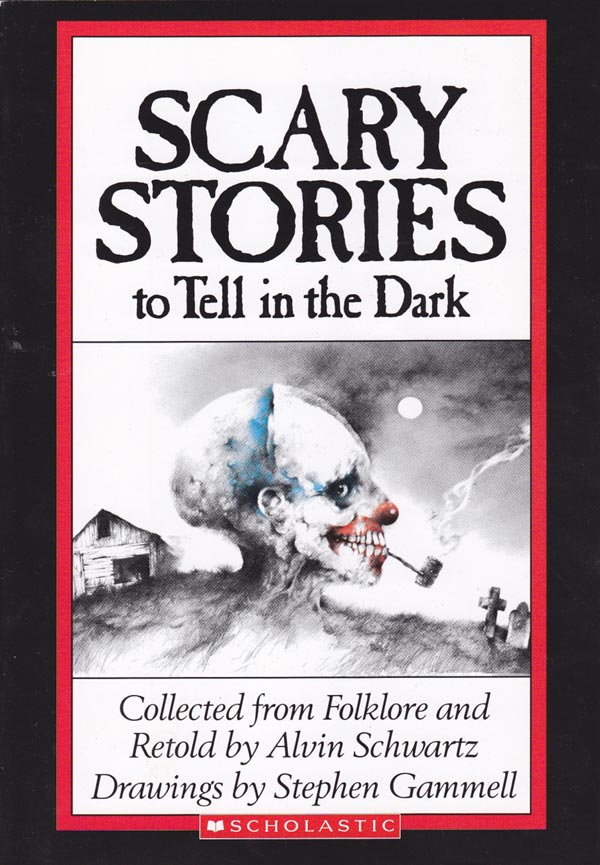
Once again, the season of autumnal gloom has descended upon us. As Halloween arrives, I find myself looking through the pages of a small set of books, admiring the artwork that once terrified me as a kid. Eventually I come across a black book with a red border with the words “Scary Stories to tell in the Dark” printed in large black letters. Below the letters is a macabre image of a skull with the familiar red “Scholastic” logo at the bottom, resurrecting old memories of book sales and small paper catalogs passed out by grade school teachers in homeroom.

The infamous cover image. Book cover art is
© HarperCollins

Scary Stories to Tell in the Dark is a series of books written by the late Alvin Schwartz and featured the infamous drawings by Stephen Gammell. Featuring stories such as “What Do You Come For?”, “The Dead Man’s Brains”, “Such Things Happen”, the three books—Scary Stories, More Scary Stories, and Scary Stories 3 –were the subject of controversy due to their chilling imagery and were consequently the most frequently challenged series for library banning from 1990-99 (“100 Most Frequently Challenged Books”).  The series was also challenged from 2000-2009 and was the 7th most challenged series for the decade (“Top 100 Banned/Challenged Books”). 

 
Notwithstanding being challenged multiple times, the series has survived and or continues to be a classic collection for spooky stories. To celebrate the 30th anniversary of the series, Scary Stories publisher Harper Collins rereleased the series with new illustrations by Brett Helquist, best known for illustrating Lemony Snicket’s A Series of Unfortunate Events. This change in illustration angered many who found Helquist’s illustrations lacking in their depth of displaying haunting detail in comparison to Gammell.  Quite simply, “Gammell’s  skill at reaching into the darkest depths of his imagination and returning with vivid nightmares which he then captured in all their macabre detail through his paintings is, simply put, unmatched”(Pellegrini). It is a disappointment, as the stories lose the intended impact that Gammell’s drawings created. Mark Pellegrini’s article “Scary Stories to tell in the Dark:Gammel vs. Helquist” provides a helpful juxtaposition between the artwork of the two editions. 
 
Despite the years of controversy, the Scary Stories series has remained as an important source of inspiration and nightmare fuel for many children of the ‘80s and 90s and has recently received some attention. CBS Films hired screenwriter John August to rewrite a screenplay after the previous version, written by Saw writers Marcus Dunstan and Patrick Melton, was thrown out (Hall). Moreover, the series is also the focus of a documentary directed by Cody Meirick—Scary Stories: A Documentary, which aims to highlight the legacy of the series, the history of gothic children’s folklore, and the impact of illustrations on young children. “In addition, to tackle the books as a subject inevitably involves the topic of censorship amongst children’s literature. Using the most censored modern example of this practice, this documentary intends to shine a light on the practice and explore the many facets and opinions involved with challenging children’s books in America” (“Synopsis”). Be sure to visit the documentary website if you wish to learn more about this exciting project. 

Honestly, I cannot recommend this series enough. The books offered a unique angle unlike other scary story series such as Goosebumps; though Gammell’s illustrations were extremely frightening to me as a child, there was an unmatched charm with these books that drew me to them. I have many fond memories flipping through the pages, thoroughly engrossed in the horrors that awaited the unsuspecting victims. Schwartz did not talk down to his audience but instead challenged the convention of what is allowed in children’s literature. Today, the series serves as inspiration for my art projects and general aesthetics. 

The original print of these books, while not impossible, is a bit difficult to come by, but I do suggest searching eBay, Thrift Books, or visiting a thrift store if you would like to acquire the series for yourself. If you’re having difficulty locating a copy, you can still celebrate this wonderfully dark day by dimming the lights, cozying up with a snack, and listening to the incredibly recorded audiobooks fill the emptiness of the room. 


To continue the festivities, I also created a Halloween playlist, "Pumpkins and Old Records" (link in case the playlist doesn't load), and you can also listen to last year's playlist if you wish. I suppose my Halloween playlist will officially become a tradition of sorts.


Here is the track listing in case YouTube doesn’t load:

Screaming for Emily—The Love
Your Funeral—I Wanna Be You
Screaming Dead—Lovers
The Legendary Pink Dots—Lisa’s Party
45 Grave—Riboflavin
Cinema Strange—Moundshroud

Cinema Strange—Finger Broken Branches (Instrumental)

Scarecrow—Mother’s Calling

Exces Nocturne—L’Echo des Lumières
Specimen—Dead Man’s Autochop
Siouxsie and the Banshees—Head Cut
Bauhaus—St. Vitus Dance
Oingo Boingo—Dead Man’s Party

I try to focus more on songs that usually aren't included in Halloween playlists, so if you like any of the featured bands, be sure to check them out.


Lastly, welcome and thank you to new readers! I truly hope you enjoy your stay.


Have a deathly decadent Halloween♥

Sources Cited:

“100 Most Frequently Challenged Books: 1990-1999”. American Library Association. N.d. Web. 15 October 2015. (link)

Hall, Jacob. “‘Scary Stories to Tell in the Dark’ Will Get Rewritten by ‘Frankenweenie’ Writer John August”. The Movie Network. 18 November 2014. Web. 23 October 2015. (link)

Pellegrini, Mark. “Scary Stories to Tell in the Dark: Gammell vs. Helquist”. Adventures in Poor Taste. 18 December 2011. Web. 14 October 2015. (link)

“Synopsis”. Scary Stories: A Documentary. 2015. Web. 23 October 2015. (link)

“Top 100 Banned/Challenged Books: 2000-2009”. American Library Association. N.d. Web. 15 October 2015. (link)


Friday, October 17, 2014

In Defense of Dark Things

With Halloween approaching, I find myself snatching up the strange and creepy ornaments for my everyday décor, only to be frequently inundated by a rather annoying question. It’s a question that often leaves me throwing my hands up in resignation while the asker either backs away or distorts their face into a disgusted grimace.

“Why all the skulls and scary things? Do Goths just have some sort of infatuation with death?”

My appreciation for skulls and other dark things has nothing to do with shocking the “mundanes”, conforming to non-conformity, or some other nonsense. My love for the darkness goes beyond the surface; its spidery tendrils are rooted in my outlook on life. To supplement my arguments, I've cited quotes from other Gothic individuals who seem to share my views on having a dark aesthetic.

Of course, my opinions are not shared by all. Not every Goth enjoys horror movies or morbid imagery and not every person who loves horror movies or morbid imagery is Goth. I seriously want to emphasize this; while there are Goths who may share my views on this subject, there are those that don't.

To continue, there is a sobering feeling when returning from a cemetery walk, as the tombstones and empty surroundings serve as a reminder that everything is temporary and will eventually lead to death and decay. It is with this attitude that life can be appreciated, as opposed to the shiny, prepackaged materialistic selfishness that continues to plague our society.  Jennifer from the website Sunlight and Shadow writes,

As far as the Gothic “obsession” with death, the more appropriate word might be “acceptance”, or “acknowledgement”, or “respect”…The Gothic viewpoint on death is one of acceptance of the fate that awaits us all, rather than “whistling past the graveyard,” denying death, and hoping it’ll just go away.

In addition, one of the ways some Goths deal with death or dark subjects is by “…look[ing] at the dark side of life—the deathly, the dystopian, the twisted, and bringing it into the light whether by turning it into macabre high art or looking at it with humour or turning it into something adorable,” writes The HouseCat of the blog Domesticated. The skull necklaces, bat earrings or morbid artwork that can be found by various members of the scene exemplify this.  

Often the love for the dark, strange, and morbid is a reaction to the constant injustices and suffering that individuals unfortunately face. In his eloquent video, "Why are you so fascinated by the macabre?", YouTube user The Count asserts that “Goths tend to embrace the sinister as a means of coping with injustices in the world. They feel anger towards personal injustices, which is then projected outwards towards social injustices.” Some Goths are critical of these sanitized "everything is just peachy" attitudes due to experiences in dealing with the underlying hypocrisy of their adherents. These experiences, whether personal or impersonal, challenge the ideals of mainstream society. Voltaire states in his book, What is Goth?,

The underlying philosophy of Goth is that our society is predominantly hypocritical…Goths hold that the ‘normal’, ‘upstanding’ members of our society who pretend to be ‘good’ all of the time are in fact capable of doing great evil. This is because Goths are often people who were victims of some kind of abuse—physical, verbal, or emotional—at the hands of these very same self-righteous folk (Voltaire 15).

The struggle of inner morality is an interesting subject to delve into.  I once wrote on a social networking site that the one defining characteristic of darkness is that it strips us off every pretense and security, every excuse and invented identity, down to the core where only the true self remains. It is in this moment that your true motives, intentions, and character are the only thing that clothe you. Darkness is a mirror that reflects the shadow nature to everyone--and ourselves. Just because something is considered uncomfortable or offensive doesn't mean it should be ignored.

It is also a matter of taste. I find things like cemeteries, bleak mornings, and abandoned places aesthetically pleasing. The coffin rings and bone jewelry are beautiful items I wish to adorn myself with. I adore horror movies, macabre art, and oddities because that is what I find beauty and excitement in and that is what pleases me.

For a more eloquent response to this oft answered question, the aforementioned video and these podcasts delve into discussions regarding the macabre and death (the podcast focuses more specifically on the latter).


Sources Cited:

Doneske, Jennifer. “Gothic Myths and Gothic Facts”. Sunlight and Shadow. 27 March 2007.             Web. 11 October 2014. (link)

The Count. "Why are you so fascinated by the macabre?". Online video clip. YouTube, 24 Feb 2003. Web. 12 October 2014. (link)

The HouseCat. “What IS Goth?”. Domesticated. Blogger, 10 December 2011. Web. 13                          October 2014. (link)

Voltaire. What is Goth?: Music, Makeup, Attitude, Apparel, Dance, and General                                      Skullduggery. Boston:  Weiser Books, 2004.